Recycling and Sustainability for Landscapers Millbank
 Landscapers Millbank is committed to delivering an eco-friendly waste disposal area that supports responsible clearing, sorting, and reuse of green and general waste. Our aim is to make every sustainable rubbish area we manage cleaner, more efficient, and more aligned with local environmental priorities. By combining practical waste segregation with low-emission collection methods, we help reduce the amount of material sent to landfill while improving recovery rates for recyclable and reusable items.
We work with a recycling percentage target designed to keep the majority of suitable waste out of disposal routes. Our current goal is to recycle or divert at least 85% of collected material wherever the waste stream allows it. This includes soil, timber offcuts, branches, plant cuttings, metals, cardboard, and selected hard plastics. By separating materials at the point of collection, Landscapers Millbank can support a more sustainable rubbish area and reduce unnecessary contamination that can undermine recycling performance.
 Waste separation is especially important in central and inner London boroughs, where collection systems often rely on clear sorting between green waste, mixed recyclables, and residual waste. Our approach reflects that borough-led emphasis on cleaner separation: we sort organic landscaping waste away from general rubbish, and we identify recovery opportunities for aggregates, wooden fixtures, and packaging. This helps support the local system and improves the chances of materials being processed at the most suitable facility.
For many projects, we use local transfer stations as a practical step in the recycling chain. These facilities help consolidate loads before materials are sent on for specialist processing, making the transport route more efficient and reducing the number of long-haul journeys. In the Millbank area, access to well-managed transfer stations can make a meaningful difference to both carbon output and recycling outcomes. By choosing the most appropriate transfer point for each waste type, we help create a smoother path from site clearance to recovery.
Our landscaping recycling practices are designed to match the needs of the area’s mixed urban environment. That means handling everything from hedge trimmings and turf to broken pots, metal edging, and soil spoil in a way that prioritises reuse. Organic waste is directed toward composting or biomass routes where available, while inert materials can be screened and reclaimed. We also place careful attention on contamination control, since even small amounts of mixed rubbish can reduce the quality of a recyclable load.
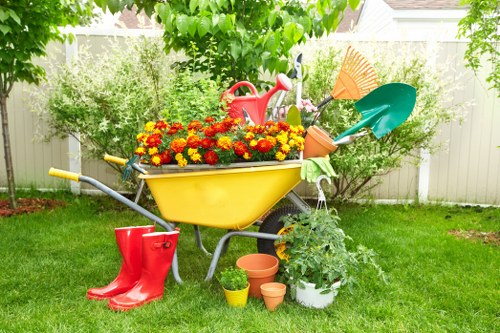 To strengthen our sustainability commitment, Landscapers Millbank works in partnership with charities and community reuse organisations when suitable items can be donated rather than discarded. Usable tools, timber, planters, outdoor furniture, and surplus materials may be routed toward charitable reuse where they can support local projects, gardens, or community spaces. This approach gives a second life to items that still have value and keeps them within a circular economy rather than sending them to disposal.
We also recognise the role of transport in shaping the environmental footprint of waste handling. That is why our fleet includes low-carbon vans designed to reduce emissions across regular collection and disposal movements. Where possible, we prioritise efficient route planning, reduced idling, and shared-load scheduling to lower fuel use. These measures are particularly helpful in dense urban districts like Millbank, where short trips, frequent stops, and traffic conditions can otherwise increase emissions.
In practice, sustainability begins with how a site is cleared. Our teams separate green waste from builders’ rubbish, keep recyclable packaging apart from mixed debris, and isolate materials that may be suitable for refurbishment or donation. Recycling for Landscapers Millbank is not only about collection; it is about planning waste pathways so that each item reaches the most suitable destination. Whether it is compostable cuttings, reusable stone, or recyclable metal, the right stream can improve both environmental and operational outcomes.
We also pay attention to borough-specific waste expectations, particularly around source separation and contamination avoidance. Many local systems encourage residents and contractors to keep food waste, dry recyclables, garden waste, and residual waste apart, and that same principle benefits landscaping work. By mirroring these separation habits on-site, our sustainable rubbish area becomes easier to manage and more effective at recovering value from the waste stream.
Eco-friendly waste disposal is more than a box-ticking exercise for us; it is a working method built around lower environmental impact. We evaluate each load to determine whether it can be recycled, composted, reused, or sent to a transfer station for further sorting. This careful process helps reduce landfill dependence and supports the wider goals of cleaner streets, healthier green spaces, and responsible resource use across the Millbank area.
 Our sustainability plan also includes the careful management of soil and rubble from landscaping projects. Clean soil may be screened and reused, while stones, bricks, and inert fragments can often be recovered through appropriate local processing routes. Mixed loads are assessed to ensure that recyclable parts are not unnecessarily lost, and that only genuine residual waste leaves the system as final disposal.
To keep performance high, we regularly review how different waste streams are handled and look for better recycling outlets. This includes recognising seasonal changes in garden waste volumes, managing bulkier pruning debris efficiently, and choosing the best route for items with reuse potential. By doing so, Landscapers Millbank can maintain a reliable balance between practical site clearance and a stronger sustainability result.
 The result is a sustainable rubbish area model that supports local environmental goals while staying useful for everyday landscaping work. With a recycling target of 85% or more, partnerships that favour reuse and charitable donation, local transfer stations that streamline handling, and low-carbon vans that reduce transport emissions, our approach is built around continuous improvement. For projects in Millbank and the surrounding boroughs, this means waste can be managed with greater care, less carbon, and a stronger commitment to circular reuse.

